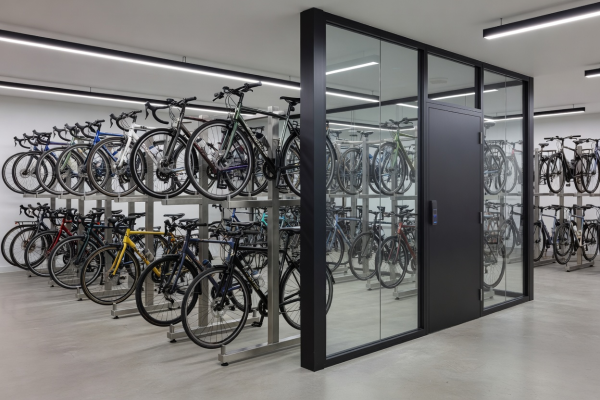
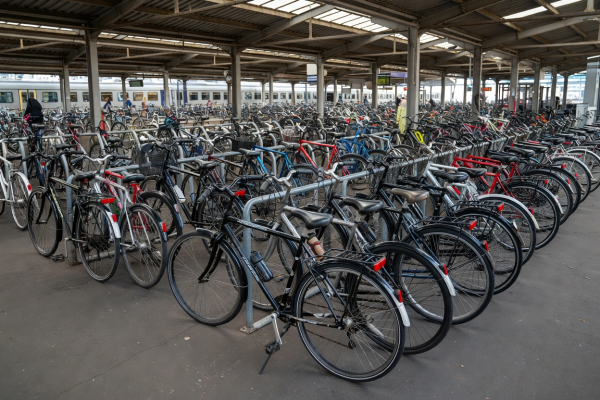
Bicycle theft across European cities has undergone a structural shift. The advent of battery-powered cordless angle grinders with diamond cutting wheels means that a standard 12 mm hardened steel D-lock can be severed in twenty-five seconds if an attacker can work in seclusion.
When designing secure cycle compounds, our role is not to promise impossible guarantees, but to calculate the time, noise, and visibility required for an attack. If defeating the facility requires five minutes of loud, spark-throwing effort under direct CCTV coverage and public view, professional bicycle thieves will move on to easier street targets.
How Layered Cycle Security Works
A secure compound relies on three concentric boundaries: the outer perimeter, the controlled access threshold, and the physical locking stand itself.
The perimeter must feature heavy-gauge structural mesh—such as 358 prison mesh or perforated corten steel panels—that resists manual bolt cutters while maintaining at least 60% visual transparency. Solid blank walls are dangerous because once an intruder slips inside, they are shielded from outside view and can take their time stripping expensive drivetrains and components.
Core Engineering Considerations
- Two-Point Locking Geometry: A stand must allow the cyclist to lock both the main frame and at least one wheel simultaneously with a single standard D-lock. Stand pipes must be at least 48.3 mm in outer diameter with a minimum 3.2 mm wall thickness.
- Ground Anchor Integrity: Stands bolted into surface tarmac can be extracted with a portable crowbar. Secure stands must be sub-surface cast into mass concrete footings (minimum 300 mm cube of C25/30 concrete per leg) or fixed with shear security nuts into reinforced concrete slabs.
- Access Control Integration: Mechanical key pads are rapidly compromised when codes are shared. We specify hardwired encrypted Mifare or Desfire RFID readers linked to the main building security database, allowing immediate cancellation of lost credentials.
- Illumination as an Active Security Element: Shadows provide cover for cutting tools. Facilities require uniform vertical lighting (minimum 150 lux at stand level) with high colour rendering (CRI ≥ 80) to assist both security cameras and human eye identification.
Low-profile floor stands that merely clamp the front tyre should never be specified for secure parking. They offer zero frame locking capability and allow thieves to bend the wheel sideways to leverage the bike away, leaving the front rim behind.
Security Hierarchy Comparison
| Enclosure Typology | Physical Protection Level | Access Method | Maintenance Complexity |
|---|---|---|---|
| External 358 Mesh Compound | High (cut-resistant mesh + roof canopy) | Electronic fob / smart lock with anti-passback | Low (galvanized steel requires annual washdown) |
| Internal Basement Secure Room | Very High (solid envelope + building barrier) | Integrated tenant access control system | Moderate (air handling, door closers, floor cleaning) |
| Modular On-Street Cycle Hangar | Moderate to High (street perimeter) | High-security mechanical cylinder or Bluetooth app | Moderate (gas struts and barrel servicing) |
Maintenance and Hardware Resilience
Vandalism resistance must extend to electronic components. Maglocks must offer a minimum holding force of 500 kg (1,200 lbs) and be protected against water ingress (IP66 minimum). Door closers must be heavy-duty overhead hydraulic units with backcheck damping, preventing doors from being slammed by gusts of wind or wedged open with stones.